Search This Blog

Showing posts with label Santa Barbara. Show all posts

Monday, April 27, 2020


A QUARANTINE PERSONAL EVALUATION…
By Silvia Uribe


I’m sorry to say this and go against the current, but I am quite content being quarantined. I’m healthy, don’t get me wrong, and I’m not dying of fear of becoming infected either, but I’d like to remain healthy. I do get around, every now and again. I like seeing what’s going on “out there.” I like talking with family and friends over the phone, on FaceTime, and seeing some of them, very few, in person. I work from home most of the time, but if I leave my fortress’ safety, to exercise or run to the store I cover my face and wear gloves, as the scientists advise. So, if I have to evaluate my social distancing is at an 85%, and I’m content with that.

I must say that the “out there” that I mentioned, seems a bit outlandish. The empty streets with mostly empty commercial spaces give an eerie feeling. However, every tone of green of the trees is greener, the sky appears brighter (either because I have less chance to look at it, or because there is less pollution, or both) and these things give me joy. The view of the ocean is completely unobstructed and the sense of calm, due to the abundance of birds singing, and the lack of car noises, is like a river of peace. 

However, there is one thing that disturbs me more and more, as the days go by. Face masks. As necessary as they are, they make me sad. Why? It is simple. I miss your face! I may or may not know you, but I miss your face. With the masks we are faceless beings, moving from place to place, with no expression; making lines at stores with no identity that we can account for. We look cold and... generic. If, on top of wearing masks, we wear shades, it is even worse. I cannot see the expressions that your eyes convey. I cannot see the human being inside you at all.
I miss seeing my fellow humans, and I’ll be fully content when, after the quarantine, I can see your face again, with the peace of mind of knowing that both of us will be ok.

Teleworking, is another thing I love. I must admit that working from home is quite different and has its challenges. But c'mon! isn't it great to not be rushed in the mornings? I have been a proponent of this for years, and for years I encountered a myriad of nay-sayers. Today, the world is finally understanding that most of the things we do in the office can be done from afar, and in much less time. I feel validated. 

And finally come the concerns that I have: Other than those who contract the virus, of course, are the small business owners. Those who have put all their money and dreams in their venture, and they might lose everything. And their workers that relied in their now nonexistent jobs; their families, that not being able to have a steady income can’t pay their rent, or buy food, or clothing… I have the tendency of getting very anxious about things like these, things that I cannot change; because they are way over my scope of influence. So, I immerse myself in whatever I can do, like cleaning my closets of unused items and donating them to those who I know need them. And, volunteering for an organization that offers financial resources to those who can’t get any financial relieve from anywhere else. This makes me feel that I’m doing something to contribute. We all can do something. If you have a sense of impotency, I invite you to help someone you know, in any way you can. We all know people in need. We know who they are. Reach out. Don’t wait until they come asking for help. Helping others is the only recipe I know to finding satisfaction, and contentment during uncertain times. 

As for the things I cannot solve, I do my best to pray that the situation won’t get as bad as I fear, and then I put my head in the ground, as a self-preservation method.

Please, stay safe.

Tuesday, May 24, 2016

CUANDO CALLAMOS....


Por Silvia Uribe.

Cuando callamos, nuestra mente vuela,
nuestras ideas se expanden,
nuestros ojos cuchichean
lo que la boca no osa decir;
eso que intriga, que muerde o que mata,
a veces, lo que ninguno desea oir.

Cuando callamos, el sonido puro
del pensamiento no se interrumpe.
La voz tenue del alma sigue alli
y es como si guaradáramos un tesoro
que a nadie le quisiéramos descubrir.

Los pensamientos se esfuman con tan poco
y el silencio es tan efectiva proteccion,
que si lo rompemos primero
el pensamiento vuela y se escapa 
de la mano de otro pensamiento seductor

Tuesday, February 24, 2015

RECENT REALIZATIONS


EMPTY NEST OR WELCOME LIBERTY!

By Silvia Uribe


Yep. I'm the very proud mother of 2 young, smart, educated, independent women. I'm in my 50's, and I have devoted 30 years of my life to giving these human beings my very best with all my love, effort, time, advice, and most importantly, with my example. During these years, I watched them like a hawk, hovering over them, but not only to protect them – although no one would have been allowed to hurt them on my watch – it was more for guidance. It was very important for me to teach them about life, and about the art of making intelligent decisions; a handy skill that they would use all their life.

True, 30 years is a long time, but for responsible parents, as you know, time means absolutely nothing. They are up early, go to work, come back to cook and clean, and at night, if need be, they are ready to take care of an ill child. Do parents complain about this? All the time! However, if someone would offer to take care of our little one while he/she is boiling in fever, so we could have a good night sleep, most of us would have not taken the offer. Why? Because parenthood is an arbitrary and self-imposed control of our hearts, minds and bodies. However, for it is self-imposed, we simply assume it.

That’s exactly how I experienced it. My family and I went from one day to the next, with lots of love, laughter, enjoyment of life, and collectively, we took all the lessons that life gave us, and we moved right through them, until just a few months ago.

Last November, my oldest got married, and moved to a different city. Her wedding was perfect! The guests were the most loving guests. The bride and the groom couldn't be happier, and both families were walking on clouds. Everything was so perfect, that it was a rather surreal experience. When I finally touched ground again, in December, our youngest daughter made the decision of living independently, and moved out. She had contemplated the idea for a few months, and she did it.

After cleaning what was left behind, I found myself looking at the empty rooms like I have never seen them. They seemed bigger, lighter, inviting. But their rooms were not the only think that changed. All of a sudden, almost magically, my husband and I had more time to spend with each other. Go figure! Good thing we kept our love intact after all these years, right?

People ask about our empty nest. They wonder if I am doing ok with our new state of life. They say things like “Take it easy” and  “You’ll get used to it” – Hell yeah!

I’m finding out that as much as I enjoyed raising my daughters, I am enjoying the fact that I am back in possession of my freedom, my time, my house.  So, if you are anywhere near, or already at this stage that I’m in, here are five tips that may help you go with the flow faster. I'm sure you'll think of more:

1    1) Start thinking about what YOU like!  Find an interest – or two – for yourself. Whether work related, or volunteering, or doing something artistic.

2    2) Make whatever you like for dinner, or don’t. Cooking is a free ride for you now. Make it when you want, IF you want.

3    3)  Move furniture around the house, or change some pieces if you can. You are in/at a different space in your life. Make your living space reflect it.

4    4) Treat your children as the adults they are. You are now an advisor.  The fact that they don’t “need” you as they did before means that you did a good job raising them.

5    5) Redirect your energy. Time spent with our kids will always be time well spent. But, as their priorities have changed, your priority now should be yourself and your spouse or partner, if you have one.

So, it may be an empty nest now, but being able to savor our liberty again, is not only a welcomed surprise, but also a satisfying way to live life after fifty.


Monday, February 2, 2015

WE ARE A COMMUNITY

And we can come together to serve a greater purpose
By Silvia Uribe
 
This is a tale of a beautiful young woman and her family, her church family, and a caring community, and how they (we) all came together in a time of crisis.

During her birthday party, in December 2014, 17 year old Grace Fisher suddenly began to feel alarming sensations in her body. Her hands were numb and her neck sore. She insisted they call 911, and she was rushed to the hospital.  After getting to the hospital, she gradually lost all mobility. Grace had to be intubated, unable even to breathe on her own.  This came as a shockwave that hit those who know her, including her friends, and her schoolmates and teachers at Santa BArbara High School.

Due to an unknown reason Grace contracted acute flaccid myelitis, a polio-like, paralyzing syndrome that has impacted 107 children in 34 states between August of 2014 and January of this year; Grace is only the 101st child patient to be diagnosed in our country.

Although Grace had medical insurance coverage, after a month in the hospital, the medical out of pocket expenses for her family were exponentially mounting. The idea of a fundraising event was brought up. This idea resonated with the Missions Committee at the First United Methodist Church, which already had a fundraiser planned with Via Maestra Providing the food. When they learned about Grace's family situation, it was decided to make Gracie the beneficiary, instead. From that, an outpouring of love, compassion, and positive energy emanated. 

The Moiso family, members of the church, and owners of the well-known restaurant Via Maestra 42, prepared and donated food for all those who would be willing to pay $25 for a meal. Many church members, rapidly RSVP'd and signed up to help with setting up, waiting tables, dish washing, and with clean up.  Other people advertised the event via Facebook, by email, and in any other possible way. It was widely announced that 100% of the proceeds would go directly to the family. The media, KEYT3 and Santa Barbara NewsPress played a crucial role informing the greater Santa BArbara area, in a compassionate and socially responsible way.

The rest is history.

Over five hundred people, from all walks of life in our community, gathered to achieve one single purpose: To support one child and her family during this crisis.  It was refreshing to see strangers interacting with each other, greeting each other, like old friends would do, except this was probably the first time they had ever met! My self-imposed duty that day, was to clean up tables, and although my intention was not to eves drop, I couldn’t help but listening to some of the conversations. One woman said “there is something for all of us to learn out of what has happened to Grace, and it is that we are still a community and we can come together to serve one greater purpose, no matter where we come from, what we do, or who we are. We sometimes forget about that”  Totally agreed!

The results? More than $34,000 were raised, at the event, and more donations are still coming in.

You can still make a donation:
Gracie Fisher Fund
308 Paseo Del Descanso
Santa Barbara, CA 93105

Grace was air transported last Wednesday, and she is now at the Craig Rehab Hospital just outside of Denver, Colorado. For updates on Gracie’s progress, see web site:   http://www.posthope.org/gracefisher  

If you are interested in sending Grace and her family a note of hope you can do it at:

Hospital Address: Craig Hospital
c/o Grace Fisher
3425 South Clarkson St.
                                Englewood, CO 80113 

Tuesday, May 29, 2012

WHAT'S NEW IN GOLETA?


 By Silvia Uribe


Living in Goleta, we don’t always notice all the construction that happens over time in our city, but the reality is that there have been a number of new things in Goleta in the last few months that have made Goleta a more dynamic, safer, more welcoming, and earth-friendlier city.

For those who have not been paying attention to all the changes our city has undergone lately, here’s a list of five things that I can remember off the top of my head, including of course, my humble evaluation of these changes:


Winchester overpass
1) The new Winchester overpass — It is great! Wider and with sidewalks, so everyone can cross the freeway in a much safer way. But turning from the overpass to the northbound on-ramp is a little cumbersome during the day, and trying to do it at night is plain dangerous, to say the least. This point is, there's a screaming need for better signage, or a terrible accident is imminent.

2) Montecito Bank and Trust — This is the "new bank on the block," if you know what I mean. Its building is nice and smartly located at the very corner of Storke Avenue and Hollister Avenue. I’m saddened, though, that it covers part of the mountain views as you come in from North Hollister Avenue. I know that things have to change, and the landscape of the city is not the exception. But, due to the fact that I grew up as a city girl, around tall buildings only, I wrestle with the romantic idea of keeping the open views of the mountains, and the citrus groves, which my family and I have enjoyed during our 14 years here in Goleta.

3) You have probably seen traffic cones and very tall cranes along the 217 Highway — You will probably see them around for quite some time. Yes, they are there because the San Jose Creek Restoration Project is ongoing. The City of Goleta is preparing for the installation of precast concrete panels up and down both sides of the creek. In the end, the creek will be deeper and easier for fish to pass.

Please remember: Safety is first! Obey all traffic signs, and remember that this is an active construction site. Do not try to get too close to it.

4) The Camino Real Hotel on Storke Avenue and Phelps Road — This hotel is going up fast, and pretty soon it will be ready, I’m sure. We know that the demand for rooms during graduation time at UCSB and Dos Pueblos High surpasses existing capacity, but I wonder if the flux of tourists in the area will be there throughout the year. The owners seem to think that they will have no vacancies for the most part. They must know better than I do, and I wish them well.


5) This construction hasn’t started yet, but Goleta will have its first roundabout in the months to come (top picture) — It will be located at the intersection of Los Carneros Road and Calle Real. This will definitely be an improvement on the dangerous three-way intersection there now, which has an elevated number of side-impact collisions. However, I know by experience that using roundabouts is not always an easy thing for everyone. If you missed the workshop that the city offered but would like information on how to appropriately and safely use a roundabout, don’t hesitate to email the project manager, Rosemary Gaglione. Her email is rgaglione@cityofgoleta.org.

It is amazing to me how little-by-little our city takes its own form and develops its own personality and culture. I’m so thankful for those who had the vision of a vibrant city and worked really hard for the City of Goleta's incorporation. I have the pleasure of knowing several of these visionaries, starting with our city’s first mayor, Margaret Connell. Some of the others are also well known to the community through their participation in government, but there are some unsung heroes who, through their silent but constant work, have shaped our city’s future.
We can all contribute to it by taking care of this great city and making sure the right people lead our way in the years to come.


Saturday, December 24, 2011

Free Expression with No Reservation

First Amendment Applies to Religion, Too


This season, we’ve heard a lot of conversations regarding the expression of religious beliefs. One big reason for the revival of this old discussion is Tim Tebow, Denver Broncos quarterback. He kneels down right in the middle of the field and makes hand and head gestures that unequivocally show that he is a believer.
Many criticize him, arguing that this could make some people uncomfortable. Some believe that this is an imposition of his faith upon those who don’t share the same beliefs, or any religious beliefs for that matter. Is that so? Hardly.


When someone openly displays his or her faith, it is not a signal that others have to follow suit. The only expectation is that they will make a connection with the higher power they believe in. They are exercising their freedom of expression. That is it! His reasons for doing it so publicly? Your guess is as good as mine, but I truly think it is none of our business.

Is there any valid reason to take that freedom away from him or anyone? Perhaps non-believers have nothing to express in this regard – but surely that should not remove others' right to express their faith.

If we extrapolate this reasoning to a completely different realm, it would be very difficult to make any sense of it. Consider, for instance, if those who have no car, because they prefer walking, were able to force others not to use their car either; or if, because I choose not to buy in Wal-Mart, others were not allowed to get in these stores. You get the idea.

This time is different from the Inquisition time. Today, most believers have no problem knowing and accepting that others may be agnostics, or atheists. Why should agnostics or atheists have a problem accepting the fact that others have a faith? I am convinced that in the same way no one should judge, or impose action on others, no one should impose the absence of action either.

To each his or her own, and everyone should be able to act, as far as religious matters go, in the way they feel most comfortable, without having to please anyone else.

Saturday, November 26, 2011

There's Runners and Then There's Runners

A Taste of the Santa Barbara International Marathon 2011


I heard cheers and claps coming from who-knows-where. "What’s that?" I thought, turning and snuggling even deeper in my bed. The noise continued. What the heck? Who’s yelling, and why? On a Saturday morning, my place at the end of the woods is quite peaceful — usually. It was not very early, but I had been out the night before, and at 7:30 in the morning my eyes resisted opening as if they were super-glued shut.

When I first peeked beyond my balcony, I could see people standing, jumping up and down. Then, looking a little further, I saw some runners coming down the street. Of course! I had completely forgotten that the Santa Barbara International Marathon was taking place, in both Goleta and in Santa Barbara.


It’s been a long while since I was a runner. Many years, to give you an idea. However, the whole running thing came back into my life when my best friend Lucy picked it up. She took it very seriously, as she does just about everything. I never did. For me, it was an invigorating thing to do and a great opportunity to enjoy the freshness of the early morning, feel the wind on my body, and see the greenery in the huge park where I ran. I did it to fill my senses, to replenish, day after day, my desire to “smell the roses” and to ponder the ideas that were relevant at the time. It would have never occurred to me to make that peaceful alone-time a competition.

With Lucy, the story is very different. She runs every day, seven days a week. When she doesn’t run, she’s in trouble, and the rest of the world is in trouble because of her. And so, it became clear to me that it was better to encourage her running urges than to have to deal with her titter-totter moods. However, through this passion of hers, the whole runners’ culture was unveiled to me.

I learned, for example, that serious runners are incredibly committed. From their eating to their sleeping patterns, they impose increasingly rigid trainings on themselves, particularly when they’re about to participate in a race, and they constantly work on their endurance — never mind the stomach pains, the sudden cramps, or adverse weather conditions. Sometimes runners suffer strain fractures, which take months to heal; other times their toenails turn black and fall off due to their toes smashing against the running shoes for extended periods of time.

They also have to learn how to run. Although one would think that this is a natural thing to learn when we’re toddlers, serious runners learn how to save the most energy — from pacing themselves, to running with their arms next to their body, without swinging too much from one side to the other — you get the picture. They are competitive in a very personal way because when they compete, really, they only compete against themselves. And so it is that, little by little, they reduce their time — even by a few seconds — and become faster runners.

I could never have that kind of patience, dedication, and commitment. But to get back to my point, more than half of the marathon happened in Goleta (a little over 15 of the 26.2 total miles). It started at Dos Pueblos High School, jumped the freeway and went down to the Ellwood area, then to Winchester and back up to Cathedral Oaks until it reached the Turnpike area. Then it continued through Santa Barbara, ending at Santa Barbara City College.

No matter that I had forgotten about the marathon up to that moment. Once I woke up enough to be aware of what was going on just outside my window, I immediately threw on my jeans and a T-shirt, brushed my teeth and my hair as quickly as possible, and grabbed a sweatshirt as I rushed out the door to join the crowd less than 10 minutes later. I didn’t want to miss the sight of those incredible people who are able to do something that I never will.

This is the kind of community event that Goleta residents, like myself, love to see happening in The Good Land, events that provide our children with a good example of how to live a healthy life and show them how to use their free time doing something positive and exciting at the same time.

I’m happy to report that the Santa Barbara International Marathon, with over 5,000 participants, was a great success this year, and it is only expected to become better every year. Next year’s race will be on Saturday, November 10, 2012. If you want to register, or if you want more information, go to sbimarathon.com.

Monday, August 22, 2011

ONCE UPON A TIME...

Four-Hundred Dollar Guests Were Treated Like Second-Class Citizens


By Silvia Uribe


A few weeks back, Great Britain’s most famous living royal couple — William and Kate — were scheduled to visit the Santa Barbara Polo & Racquet Club in Carpinteria. As much as Carpinterians were hoping for the pair to take a stroll in town, it never happened. Others were wondering if the future King of England and his newly wedded wife would visit our neighboring city, the very aristocratic Santa Barbara, at least briefly. That didn’t happen either. People in both towns were rather disappointed.

In Goleta, however, we never entertained the thought that they would visit us, therefore were not disappointed. We simply were some sort of attentive observers of the three-ring-circus spectacle that their visit represented — the helicopter arrival, a glimpse of the prince on his horse, pictures of Kate in her designer dress. At least, one day, we will be able to tell our grandchildren, “Once upon a time, there were a prince and a princess that visited a not-too-faraway land. And although many wanted to, only very few could see them in person.”


But it was not only those living in Carpinteria, Santa Barbara, or Goleta who couldn’t really see them. Others, who thought they would, who paid $400 to partake in the occasion, and who initially felt they were part of an exclusive crowd, were pretty much excluded as well. It is true that they got inside the polo club that day, but that didn’t mean they were in the same crowd with the very distinguished guests. They weren’t allowed to come through the same door, or eat the same dinner. No elbow-rubbing whatsoever. Only the richest of the rich, those who paid $4,000, were allowed to be close to the royalty, and, possibly, have a tête-à-tête with Will and Kate.

Was it just me, or was this quite rude and discriminatory? I don’t even know whether the “poorest guests” — the ones in the $400 category — were previously advised that their donation money would be happily accepted by the prince's foundation, but that they themselves would be far removed from the main attraction; that their food would not be prepared by the same chef; that they would be treated so very differently.
I’m guessing they didn’t know this. I cannot believe that someone would knowingly submit to such — in my opinion — humiliating treatment. I would’ve been furious if I had paid that much money for a boxed lunch and second-class treatment. Plus the money they probably spent on their attire — just for their own next-door neighbors to see? I hope the $400 guests were at least handed a pair of binoculars each, to be able to get a glimpse of the famous couple, if only from across the polo field.

When I knew what really went down during this event, I thought of something my father often said: “It must not feel good to be among the poorest at the party.” It never made more sense to me than on this occasion.

So, if you felt either directly or vicariously offended by the way in which this event was organized, and the guests were treated, you’re not alone. I’m with you.

Wednesday, January 5, 2011

The Debate Over A Deadly Bridge

By Silvia Uribe


This is the story of a bridge over which a huge dispute has erupted and continued for years now. The yeast of the argument is not that uncommon, if you think about it: beauty vs. practicality.


Some, don’t want to disrupt the beautiful view that we can enjoy while traveling through the bridge, while others emphatically argue that the benefit of the barrier surpasses anything else.


I’ve heard all sorts of well thought-out reasons on both sides, interesting points all of them, but the question remains: should the Cold Springs bridge barrier be finished?


As true as it is that many desperate souls have made the decision to take their own life by jumping off the bridge, it is a fact that if they don’t jump off the bridge, they could probably find another door knob to turn, and take the false gate to solving their problems. The key word here is “probably” keep that in mind.


However, being the practical woman that I am, I completely support the barrier. Here is why.


a) Nature has already been disrupted by the mere construction of the bridge that’s already there, but because it serves many of us to go through the pass, we didn’t oppose it. Many were benefitted by it, and that was a practical decision.


b) The barrier in dispute will be translucent and won’t stop our view of the valley, and


c) With the barrier, the bridge won’t represent such an easy path for those who want to end their lives, and by obstructing and delaying their intention, the barrier might just save those lives.


I’ve worn and still wear many hats in life. Working with victims of crime is one thing that has taught me a lot. Many of these victims, had great difficulties in dealing with the consequences of such crimes, and several - more than one would like to think- consider suicide. From them I’ve learned that it only took someone listening to them, or making a verbal contract for them to snap out of the moment, and realize that there are other alternatives.

Not because someone tries, or thinks about committing suicide they are condemned to do so. So, not everyone who considers jumping off the bridge will look for an alternative to accomplishing the same purpose.


To me, natural beauty and life are one and the same. We cannot care and preserve the former if we don’t care and preserve the latter. If someone is not there to enjoy nature, what’s the value of its beauty? By the same token, enjoyment should not fly in the face of life preservation.


Consider this: If your loved one were at risk of committing suicide – and we know that the bridge is a magnet in those cases – would you choose the practical solution of the barrier, or would you choose to preserve the view instead?

Friday, August 20, 2010

Watch Out! Not All Doctors Are The Same...

­­­­August 21, 2010


By Silvia Uribe


Doctors exist to make people’s bodies heal, and work well. That’s a pretty general expectation of doctors everywhere. How are doctors supposed to accomplish this? It varies from culture to culture. Some may heal with “magic”, while others, like in some Latino cultures, with rubbing and massaging with ointments, combined with some sort of witchcraft also known as “limpias” (to clean the body and the soul). Other cultures fight illnesses with thin needles, or with herbs that bring relief to those who suffer from ailments.

Regardless, there are some steps that body healers have to follow. 1) They need to take the time to listen to their patient, ask the necessary questions, and assess what the problem may be. 2) They need to determine a treatment path – ranging from an aspirin to a surgery, and everything in between – and to evaluate the results of such treatment, and 3) If the treatment is not working, doctors are supposed to re-evaluate the situation and make adjustments to the treatment.


Logically, the common thread that runs through all these steps should be a constant flow in the communication doctor-patient-doctor.


However, some doctors don’t even deserve the title. They’ve seem to have forgotten one or more of these logical steps, starting with taking the time to listen. They seem to think that communication with the patient is not important, thus cutting it to a bare minimum, and relying on what the nurse refers to them, and what the records in front of him read. You may know the kind. These doctors I’m talking about whoosh in the room, ask you how you feel, start writing by hand or in the computer, and whoosh out before you know it, just to go onto the next patient whooshing again. Sometimes they barely look at you. Sounds familiar?


My elderly friend Graciela went through a terrible experience after a knee surgery followed by an infection, her doctor left her bed-bound for months on end. It was as if he had forgotten about her. All that time, he just let her suffer from great pain and desperation. The infection prevented her wound from healing, and he wouldn’t do anything about it. She became so frail, that we feared for her life.


Finally, after almost a year, and pushed to see her by her frequent calls, he decided to take the infected prosthesis out, place an anti-biotic pack in its place, and get rid of the infection that way. What he never told my friend was that, after the infection was gone, he wasn’t planning to replace the prosthesis, and that his “treatment plan” was to leave her without the use of her leg for the rest of her life. No options or intelligent reasons were given to her for this decision. Obviously bothered by her inquiries, he only told her that by doing what he said the risk for another infection would be reduced.


As you can imagine, she emphatically insisted on the fact that she wanted to be mobile again, but his position was firm. She finally had it, and told him that she wanted a second opinion. At first, he look surprised, and maybe a little scared, then he became defensive, and seemed mad at her for “changing plans at the last minute.” My friend asked “what plans?” He told her that he had scheduled another surgery to take the anti-biotic pack out of her leg the following week, which, of course, he had not previously discussed with her.


Now, with a new doctor, and a surgery coming up, she is expected to walk again, and have a normal life.


It seems that some in the health field get too comfortable (particularly in towns where they don’t have a lot of competition) and become insensitive to their patients’ needs. They may be bored or tired with what they do, and they start doing their job just for the money, and not because they have the passion to do it anymore. They don’t want to answer questions, or to explain themselves in a way that their patients can understand. They neglect their patients and put them at great risk.

As patients, we should not put up with their attitude.

Fortunately, there are others whom deserve to be called doctors. They practice medicine for the right reasons, and devote the necessary time to understand what’s going on with their patients. They confer with them and help them understand the benefits of their recommendations, and address their concerns. They are not lazy. They keep themselves up-to-date with new treatments and preventative measures. They’re good not only with the “easy cases”, where everything goes as planned. They’re also good when things get tough, and the results are unexpected and difficult to deal with.


That’s the kind of doctor patients respect, admire and trust. Not the health “line workers” that do their job with the automatic pilot on, but the ones that are knowledgeable, dedicated, and ethical health professionals.


My virtual hat is off to the latter ones.


Cross-Published on http://www.edhat.com

Sunday, August 8, 2010

Word Has it!


By Silvia Uribe


August 8th, 2010


In Santa Barbara, we all know that a business' best advertisement tool is word of mouth. But, positive word of mouth is not cheap, and it doesn't come easily either. A business has to maintain a high standard in the quality of whatever it is they offer. Be it a service or a product, word of mouth can take any business to complete success, or it can unmercifully destroy it.How is it then that businesses gamble with their reputations is beyond me, but unfortunately they do; particularly restaurants, of which we have abundance, with a great variety of cuisines and flavors. Competition is the name of the game.


Particularly today, when online social networks allow us to post our opinions about a business, and have the potential for hundreds, at times thousands of people to see it, word of mouth should be taken more seriously now than ever. I guess some popular eateries feel that they'll be at the top forever and, at some point, they feel they can set whatever rules they want. They get used to hearing the register machine's sweet "ka-ching" sound, and they forget about why they're there, and most importantly, about the customers who put them where they are.


I'm one who believes that every customer should be treated equally well, and that the restaurants' good service, and their facilities should be available to everyone who pays their prices, no questions asked. Service standards should not be based on the best interest of the employees, but on the customers'. Otherwise everyone loses, from the employees, to the customers, and the restaurant itself.

With this in mind, and based on information meticulously gathered last month at various social encounters, I created a list of the main 20 reasons why people would stop going to a restaurant, or even worse, would give it a bad rap.


1. Bad food (of course)

2. Not letting people sit where they want unless they have dinner (and the waitress explaining that "those who have dinner - not just appetizers - leave more tips"

3. Lousy service

4. Not bringing water when customers are seated

5. Servers and managers chatting with customers, as opposed to serving

6. Charging for to-go containers

7. Burning the food

8. Cutting too many corners

9. Split plate charges

10. Not reminding large groups (6+) that the service charge is already included in the total

11. Dirty restrooms

12. Turning people away before their closing time

13. Bringing cold food from the kitchen

14. Chipped porcelain and/or dirty silverware and table clothes

15. Strange "findings" in the food

16. Overpricing

17. Waitperson's poor personal appearance and manners

18. Overall lack of cleanliness

19. Waitperson's lack of proper training

20. Slow service

(Thank you to those who contributed their opinions.)

These reasons would somewhat vary if we were in Mexico, where flavor takes precedence over what are considered "less important things". The list would be a lot shorter.

Here is the perfect example, and my recommendation for a Mexican Taqueria; Lilly's Taqueria . You guessed it - they only sell …tacos. Lilly’s is located right where the freeway meets Chapala Street in Santa Barbara.

The place is not particularly pretty, although it is very clean. There are no waitresses, but you get your food as soon as you finish ordering it. And, they serve you on paper plates, but the ingredients and the flavors are high quality and very traditional. At a price of $1.49 per taco, you cannot believe the quality of their meat.


Now, if you are a taste bud adventurer, Lilly’s Taqueria is the best place to try some Mexican cuisine meat delicacies, and order some “lengua (tongue), cachete (cheek), or tacos de ojo (eye ball)”. Daring huh? Mmmm…mmmm


Silvia Uribe is a freelance writer with a Latino perspective


Cross-published at http://www.edhat.com

Sunday, July 11, 2010

The Human Tsunami

By Silvia Uribe

Jul 10, 2010, 9:45 AM


Santa Barbara's community events are great. Whether it is the Summer Solstice Parade, Fiesta, the Arlington Soccer Screenings, both Christmas parades, and other events - you name it - I'm usually there. My favorite, however, is the "human tsunami". You know - the mass passing underneath the freeway after the 4th of July Fireworks Celebration.

This one has become some sort of ritual for my friends and family. Ten to fifteen of us gather on State Street for a cup of coffee and some good conversation. Around 7:00 p.m., we start our pilgrimage down to the beach, or close enough to it, to enjoy the multi-colored lights and the loud booms of the fireworks, while also people watching.

When the show ends, we start walking back. It is a great sight when standing at the top of the street we can see others going under the bridge. Some run, others jump, and most walk. When they get there, everyone yells at the top of their lungs, or whistles, or makes noise in any way they can. IT-IS-LOUD! Some use their phones, while others use their cameras to capture the moment.

People in our group hold hands, creating a human chain in order to stay together and down we walk. Those who are not as noisy move their heads, pretending disapproval, the rest get more excited by the minute - everyone laughs. Other individuals walking next to us do the same. We exchange some words while we can hear each other. They are complete strangers, but we make them part of our group. We pose in their pictures and they pose in ours. It happens every time. Happiness flows - we all contribute to it.

If you have ever been to the Olympic games, or to a Soccer World Cup, you know what I'm talking about. It is the same kind of feeling of unity.

When the human tsunami comes out on the other side of the freeway, it is over. It quickly vanishes like the bubbles on the ocean's foam. The magic ends. But it leaves each one of us with a warm, positive feeling in our heart, and with the desire and the commitment to be there next year to re-live the experience.

There's an immense amount of good energy every time that a mass of people gather, and moves around in celebration of something. Some enjoy being active participants, while others, a bit less actively, enjoy with other's enjoyment. But whichever category one belongs to, the energy is contagious.

Maybe I like these things because of my Latino heritage and culture, which is, for the most part - and this is no secret to anyone -gregarious and loud. We say that when two Latinos get together, they have a conversation. When three Latinos gather, it is a party.

But there are other reasons as well.

Miraculously during these events, the old and the young, the able and the disabled, private individuals, celebrities, the rich and the poor sit next to each other for a couple of hours, completely oblivious of who the others are. We can relate as simple human beings, no strings attached. During that time, we can all share the same space, and the same kind of experience while exchanging a brief, casual conversation with one another.

This fact alone is enough to make me feel hopeful.

I also cherish the anonymity and the freedom that all these events promote. One can stand, sit on a chair or on the ground, dress fashionably or do the complete opposite. We can be extremely loud or completely quiet. We can sing, dance or do nothing. We can eat, or drink, or do both things. We can bring our whole family, be with a group of friends or come alone and spontaneously join others. Or, we can wear costumes, specific makeup, a festive headpiece or go natural.

We won't be judged by the same standards that we usually are. We are all free, and for the time that the celebration lasts, accepted as we may be. No prejudices.

This gives me enough reason to be there.

Our celebrations are a reflection of our town, our community, our families, and about each one of us as individuals. Peacefully gathering in mass with no other purpose than to be happy and make others happy is - in my book - a very healthy way to relate to each other. That's why tourists come to Santa Barbara.

On the other hand, I very much resent those who not being able to do this, engage in criminal activity during our celebrations. Thankfully, this happens very sporadically, and when it does, the rest of us don't let them take over our town, our festivities, and our sense of security.

Next year, come and join your friends and neighbors in the human tsunami, and all other celebrations. You won't regret it.

Silvia Uribe is a freelance writer with a Latino perspective.

Cross-published at http://www.edhat.com

Monday, June 21, 2010

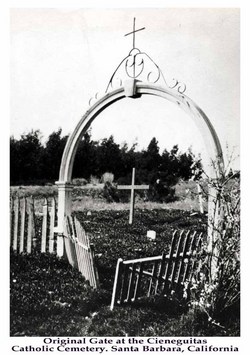
Familiar Names at Cieneguitas Cemetery in "Noleta"


By Silvia Uribe


Sunday, June 20, 2010

A reader sent me a great study by Neal P. Graffy, written in March 2001, called “The History of the Cieneguitas Cemetery.” The burial ground is also known as La Patera Cemetery, due to its location (but not to be confused with the current La Patera Cemetery), and "Old Catholic Cemetery" due to its administration by the Franciscan fathers.


According to Graffy, the graveyard in the Santa Barbara area following the arrival of the Spanish was located at El Presidio, founded in 1782, followed by the Riviera Cemetery, on the lower Eastside of the city, in or about 1846. Then, in 1870, a Catholic cemetery was established on the edge of the foothills above the town, where the St. Francis Hospital was later built. The Cieneguitas Cemetery followed in 1875, and Calvary, the one on Hope Avenue, in 1896. Cavalry is the only one that's still open.


Cieneguitas in Spanish means little swamps, and Graffy described the area as “an impenetrable jungle of small trees, brush, vines, ooze, flags, and swamp grass.” Way different than what it is now. Many of those interred at Cieneguitas were transferred to Calvary. It wasn’t until I had lived in Goleta for several years that I even became aware of Cieneguitas Cemetery, located in what’s commonly known now as Noleta, near the 4400 block of Hollister Avenue, right behind the County Coroner’s Office.


The particularly interesting thing about it is that it is one of the locations where veterans of the Mexican War and Civil War were buried.


It is important to mention that a study done by Edson T. Strobridge says that “the State of California, being located so far away from the more active scenes of the Civil War, was not called on to furnish troops for immediate service against Confederate soldiers, and no quota was assigned to it ... Nonetheless, war calls were eventually made upon the state for several regiments and battalions which totaled more than 16,000 men (plus the 500 men who enlisted in 1862 and became a part of the quota for the state of Massachusetts) and ultimately became a part of the Second Massachusetts Cavalry. With the exception of those who enlisted for Massachusetts, the California forces took no part in any of the great battles of the Civil War.”


Some of the names—most of which belonged to members of the First Battalion Native California Cavalry Company C—that you’ll see in the following list, compiled by Strobridge, who is from San Luis Obispo, on December 8, 1998, may also belong to ancestors of present residents whose families have been in the area for more than a century.


The following entries were originally made in Spanish. I’ve included the page number where they can be found in the Death Book, to make it easier for you to look them up for yourself.


Manuel German, 45 years of age, buried February 18, 1874 (p. 3)
Felipe Badillo, 56, buried July 23, 1884 (p. 8)
Vicente Ordaz, 52, buried May 21, 1879 (p. 39)
Antonio Maria de la Guerra, 66, buried January 29, 1881 (p. 53)
Bernardino Lopez, 65, buried January 10, 1884 (p. 65)
Antonio Rodriguez, 70, buried January 4, 1887 (p. 82)
Jesus Soto, 43, buried February 19, 1887 (p. 83)
Lino Ruiz, 40, buried November 8, 1887 (reinterred at Cavalry) (p. 88)
Clemente Espinosa, 42, buried January 16, 1888 (reinterred at Cavalry) (p. 90)
Francisco Cordero, 78, buried January 6, 1889 (p. 96)
Miguel Pico, 48, buried January 21, 1890 (p. 103)
Pablo Valencia, 68, buried July 13, 1891 (p. 112)
Jose de Jesus Cordero, about 60, buried December 14, 1891 (p. 113)
Jose Maria Ayala, 61, buried January 22, 1892 (p. 114)
Jose Maria Garcia, 57, buried August 3, 1892 (p. 117)
Juan Scolan (John Scollan) , 72, buried August 25, 1892 (p. 118)
Jose Rufino Leiva, 62, buried May 22, 1893 (p. 112)
Narciso Valencia, 48, buried November 3, 1893 (p. 124)
Jose Maria Valenzuela, 70, buried February 6, 1894 (p. 125)
Ismael Soto, 53, buried February 10, 1895 (p. 133)
Juan Ygnacio Valencia, 72, buried September 26, 1895 (p. 138)


It was not until October 23, 1895, in Death Book #2, that the entries are made in English rather than Spanish:


Jose Salvador Valdez, 70, buried November 17, 1895 (“in Catholic Cemetery”) (p. 139)
Nicolos Orellana, about 76, buried February 6, 1896 (“native of Chile, interred in Catholic Cemetery") (p. 141)


And the following entry marks the first burial in the new Calvary Cemetery, at 199 North Hope Avenue:


John C. Kays, 83, buried September 2, 1896 (“native of Ireland”) (p. 144)


The Cieneguitas Cemetery is definitely a trip back into our history. If you decide to visit, you’ll see pieces of sandstone that once made up a base for a headstone, or, perhaps, curbed the edge of a single or family plot.


I encourage everyone to contact me at transilpro@gmail.com with any topics about which you would like me to write in the future.


Saturday, June 12, 2010

Unfriendly Sidewalks


By Silvia Uribe

Last week I was in pain, and perturbed by the clickety-clack sound coming from my knees after falling hard on them. It was one of those, not only painful, but embarrassing moments. The kind we inevitably go through when tripping or twisting an ankle, and after making all sorts of unnatural, ungracious, and in the end, unsuccessful maneuvers in an effort to avoid the fall.

This time, the culprit was one of the many poorly maintained sidewalks of our city. I tripped, and like a dart, my body propelled itself a few feet ahead.

I landed next to a long line of cars waiting for a green light. As they slowly moved forward, several drivers stopped briefly and, through their windows, nicely asked if I was ok. (So much for my wish to be invisible, but it is very comforting to know that caring people surround us.)

Much to my disbelief, physically, I was ok. Saving face a little, I waved at them, signaling that I had no broken bones, and no acute pain. Then, I started the recovery operation - all the stuff that came out of my purse. It had opened at the time it hit the ground, allowing for my makeup, pens, phone, and other items to be dispersed all over the place. Nice.

My ego was a different story. It was badly bruised after the awkward moment. First, I was lying on the sidewalk; face down, for a few (very long) seconds. It felt weird, to say the least. Then, I sat (still on the ground) trying to clean some of the dirt from my new pants, and at the same time, feel my body discretely and assess for possible damages. Then, I came to the realization that I needed to get up. OMG! (Sorry, I'm getting used to texting.) That moment was the scariest of all.


There was nothing close to me that I could've used as a resting/pulling/supporting device. I knew I had to come up with the necessary strength in my legs and knees, and trust that they would push me up.


"I can do it, I can do it", I kept repeating to myself out loud, but I was secretly hoping for some invisible hands to lift me up. I counted "one, two, three, and…." I regained verticality. I was so proud of my accomplishment, I could have given myself a round of applause, but I refrained, since the whole scene was already odd enough. The show was over…. Finally.

Is it only me, or is our city in a major need for timely curb, and street repairs? During the time that I spend downtown every weekend, I see many people tripping, not because they're clumsy or distracted, but because more and more curbs are uneven, broken, or because the bricks are loose (as the picture shows) making them dangerous; particularly, and interestingly enough, for those who wear either high heels, or flip-flops.


And, what about our streets? The wear and tear of our cars gets incrementally accentuated with so many little, medium and big potholes (like the one at the off ramp of the 101 at Carrillo.) These take forever to be fixed, and when they are, the solution is deficient, and sometimes as bad as the problem itself.

Why wait so long? Or, even worse, why wait until something really bad happens in which the City may be found liable? They say in Spanish, "Mas vale tarde que nunca", which equivalent in English is, "Better late than never." I don't agree with that philosophy. In certain instances, it might just be too late.


As for me, I followed my own advice and took matters (my noisy knees, and my all aching body) into my own hands quickly. I immediately scheduled a visit to the chiropractor and to the masseuse, to fix and pamper myself a little.

Now, I'm ready for another walk.


Silvia Uribe is a freelance writer with a Latino Perspective.
Cross-posted at http://www.edhat.com

Monday, May 17, 2010

Community Values Forum

Discussion of Car Impoundments and Secure Communities Program

By Silvia Uribe

Yesterday in Goleta, immigrants and their allies came together to talk about what’s happening in Santa Barbara County in relation to immigration.

The goal of the Community Values Forum, organized by P.U.E.B.L.O at San Raphael’s Church, on Hollister Avenue, was to create an opportunity for community members and elected leaders to learn about and discuss issues of immigration reform and local enforcement policies that affect our immigrant community.

Around 100 people, including a handful of elected officials, including Supervisor Salud Carbajal, Santa Barbara City Council members Grant House and Das Williams, and Goleta City Council member Ed Easton, were present at the forum. A representative of Congresswoman Lois Capps read a message from her boss, and a representative of Police Chief Cam Sanchez was also present.

Those attending the event listened to a very informative panel touching on two main topics. The first was titled “Car Impoundments in Santa Barbara: Good for Public Safety?” The second topic was the Secure Communities Program, and how it operates in our criminal justice system. Attendees were also able to hear a couple of very touching testimonies on how our immigrant community suffers the most consequences from these programs.

A study presented by Greg Prieto, from UCSB, showed that in 2007 and in 2008 the number of cars impounded at check points from people whose licenses were suspended or revoked due to previous DUI’s or for some other reason, was around 300 both years; whereas the number of cars impounded from those who had no license at all (as distinct from a suspended or revoked license) went from 900 in 2007, to 1250 in 2008. What this means, Prieto said, is that those checkpoints are not making our roads safer from dangerous drivers, as they’re supposed to, but are instead hurting the immigrant population.

From this presentation, attendees learned that the law states that if a person who has no license gets pulled over by the police, the officer can use his discretion to not have the car impounded immediately, but to give the driver a chance to have someone with a valid California driver’s license pick up the car and take it away. However, this discretion is rarely practiced, and the car is almost always immediately impounded. Prieto said that in San Francisco, as a result of public pressure, police allow for a 20-minute window for a licensed driver to show up.

Mateo, a 39-year-old man, in his testimony on this issue (in a compilation published by PUEBLO, called En Las Sombras del Paraiso, or In the Shadows of Paradise) said: “It is very traumatic having to drive without a license all the time. I fear an encounter with police. Because of this fear, and my nervousness, I make mistakes that give me away with police. Now I drive a $500 car, to reduce my loss in case the police stop me and impound my car simply because I don’t have a license.”

Melissa Keaney, from the National Immigration Law Center, informed the audience that Santa Barbara’s agreement with Secure Communities was made with the Sheriff’s Office, and that it started on January 5, 2010. She ennumerated some of this program’s irregularities.

1) ICE (Immigration Control and Enforcement) is not paying attention to racial profiling cases or to arrests with no reason.

2) There is no transparency: The Department of Homeland Security has not regulated any part of this program, and there are no records to be reviewed.

3) The numbers are not clear: None of ICE publications have information on Secure Communities and there’s no provision for data collection or for audits.

After listening to these presentations and the testimonies of a couple of people, Supervisor Carbajal made the commitment to meet with Sheriff Bill Brown to talk about the current situation and how we want Santa Barbara County to be fair with all its residents.

Likewise, Das Williams and Grant House said that they will start the conversation at the Santa Barbara City Council to talk about these issues. Ed Easton said that he will do as much as he can to promote this conversation within the City of Goleta government. A committee put together by PUEBLO will be formed to follow up on these commitments in order to further the movement against discriminatory and un-American Legislation.

Silvia Uribe is a freelance writer with a Latino perspective.

Cross-posted at Independent.com

Saturday, May 15, 2010

Scrabble and Brunch

This One’s for the Library

By Silvia Uribe

For the most part, and no matter our origin, we grew up and raised our children counting on board games as a perennial source of family entertainment.

You name it, from Monopoly and Checkers to Taboo and Lotería (a Latino version of Bingo but with images instead of numbers), there were always games to remove any chance that a rainy, snowy, or extremely hot day would be boring. We knew that during those times we would get our share of laughter, praise or complaints, and, at times, sporadic tantrums, depending on the outcome of the game. It was all part of the fun.

In my family, Scrabble was highly ranked among our favorite games. Not only was it entertaining, but it put our brains and creativity to extreme work, and I liked that. I still do. That’s why I was excited when I found out that the Goleta Branch Library (500 N. Fairview Ave.) would host a Scrabble fundraising event on Sunday, May 16, from 10 a.m. to noon. The event benefits the Santa Barbara Public Library System’s Adult and Family Literacy Programs.

“Hundreds of adult learners receive free, confidential tutoring through the Santa Barbara Public Library System’s Adult Literacy Program,” said Adult Literacy Coordinator Beverly Schwartzberg. “One hundred and fifty volunteer tutors, who receive free training and materials, work in Santa Barbara, Goleta, Carpinteria, and Solvang. The library’s literacy service also offers free family literacy programs and free books to adult learners and their young children.”

For this Scrabble event, players of all levels are welcome. Schwartzberg explained, “This event is intended to be fun, not competitive. We usually have players that are outstanding, and players that are in the process of becoming outstanding. Players will be matched by experience levels, from novice to expert, according to how they rank themselves. All of them are incredibly focused on their games.”

Participants will play two timed-Scrabble rounds and enjoy a scrumptious brunch assortment of fruit, bagels, coffee, juice, and other breakfast treats. The entry fee is only $15 per person (or parent/child pair playing as a single player) and players will have a chance to win great door prizes from local businesses. You can come by yourself or bring all your friends!

I found out that this event is a warm-up for the Sixth Annual Scrabble Night for Literacy, to be held Friday evening, September 24, 2010, at the Santa Barbara Central Library. In order to put this event together, Schwartzberg has the help of AmeriCorps volunteers, and the Friends of the Santa Barbara Public Library.

Among other great programs, held at the library, there is the Outreach Program that offers free story times at local preschools in English or Spanish, free book distribution to elementary schools, and more. Their soon-to-come Summer Reading Program offers book reading contests and summer performances. They also offer computer coaching for adults (a very popular course) and many other interesting things.

No wonder volunteers love to give their time to the Public Library. They are constantly active behind the scenes.

For more information about literacy programs and for reservations and inquiries about “Scrabble and Brunch” send an email to ScrabbleLibrary@gmail.com, call (805) 564-5619, or check the library’s Web site.

Silvia Uribe is a freelance writer with a Latino perspective.

Cross-posted at Independent.com

Saturday, April 24, 2010

Community Flavor vs. Panhandling

By Silvia Uribe

The issue of panhandlers is viewed by many as a nuisance, and by others as true social negligence. Some say that panhandlers discourage them from walking downtown. For me, this problem is not enough to preclude my enjoyment and pride for Santa Barbara, which doesn't compare to any other place I know. Here is why.

Last Saturday night for instance, I found myself standing on State Street, across from Paseo Nuevo, listening to a group called "The Blasting Sound". The rambunctious music was not ear splitting, as one might assume by their name. It was rather powerful, rhythmic, and definitely inviting.

Very much like a magnet, the young music players attracted groups of around 30-50 people each; passersby that stopped to listen, and left when the musicians took a very brief break after several songs. Altogether, about 300 plus people stopped for at least 15 minutes to listen to them.

People on the other side of the street were not immune to their magnetism. They were also clapping loudly after each song. Since I was not planning to leave any time soon, I decided to join those across the street, have a cup of coffee, and continue enjoying the serenade. The Blasting Sound played what seemed to be old European songs mixed with some Middle Eastern tunes for about 2 hours, almost non-stop. It was a real treat.

However, good music is not the only entertainment that you can find here. In Santa Barbara, there's something for everyone, and the entertainment happens everywhere, all year long.

You can find colorful balloons made by a world recognized balloon maker in the form of flowers, animals, or whatever else that pleases your taste. Or, exotic entertainment, like petting snakes big and small. There are drummers, and High School trashcan players. A dog, a cat and a rat piled on top of each other strolling down the street. There are random singers in English or in Spanish (how international!). There are skillful jugglers, and a street cartoonist capturing people's mementos.

If this is not enough, think about the entertainment that people like you and I provide for those who enjoy people watching, or about those who proudly drive their jumping low-riders, their impressive bikes, or their ultra expensive, envy provoking cars. And how about dogs? Small, big, medium, dressed up, in strollers, or socializing and allowing people to pet them.

For those who enjoy food, Santa Barbara is like the Garden of Eden, offering delicious, luscious, and at times, sinful bites; from traditional American food, to exotic dishes from around the world. A number of these eateries offer outdoor seating on the sidewalk, for patrons to enjoy the city's ambiance, and beautiful days and nights.

Not too far away from downtown, all sorts of festivals appear like wild flowers in the country during the warmer season: the French, the Italian, the Greek, Fiesta (for 5 days), ‘I Madonnari' for those who love art, music and food together, Earth Day, Cinco de Mayo, and a few more that escape my memory.

The social networking that takes place at any given moment right on the street is amazing. Living here, one can find (every three steps) some family member, friend, or co-worker. Lost tourists asking for directions (to the place right in front of them) and, at times, celebrities enjoying a rare opportunity for certain degree of privacy, and being able to take a calm stroll, just like anyone else.

We have the movie theatres, the many coffee shops, and all the shopping one might want. And, please don't forget the magnificent vistas of the ocean, and the mountains, the sunrises and the sunsets, and the unmatchable weather of the California Central Coast, which set our city apart from any other place.

No, I'm not being blind to the panhandler issue. But, with so much beauty, so much entertainment, and so many good and fun people around us, it is practically impossible for me to focus on one problem as opposed to enjoying all the good in our vibrant town.

How can we, then, deal with the panhandler issue? In the most effective way: with our volunteer work, and/or our money.

In the meantime, we can continue to dote upon the quality of life that we have in Santa Barbara, the entertainment opportunities that it offers, and the friendly (for the most part) community around us.

Silvia Uribe is a freelance writer with a Latino perspective.

Cross-posted at edhat.com